

After spending nearly six months attached to the International Space Station, ESA's Jules Verne Automated Transfer Vehicle (ATV) made a fantastic atmospheric re-entry today. And by fantastic I mean complete spacecraft vaporization as shown in this first known picture taken from an airborne DC-8. What remnants survived the re-entry splashed down into the Pacific Ocean. Jules Verne made such a spectacular show for those who could see it because it was so huge to begin with. Compare it below to the size of both the Apollo and Progress spacecraft. Jules Verne "carried almost five tonnes of food, breathing air, drinking water and fuel" to the ISS. Of course in typical fashion, Verne was discarded after it's use was no longer needed. ESA has at least two more ATVs in production for future launches. With more than 100 years since Jules Verne's death I'm glad to see he finally completed le voyage extraordinaire.

[Gizmodo]
Home to PointNiner
Showing posts with label ISS. Show all posts
Showing posts with label ISS. Show all posts
Monday, September 29, 2008
Jules Verne's Terrific Re-entry


Sunday, September 28, 2008
SpaceX Falcon 1 Finally Makes It Into Orbit
 Well I guess SpaceX CEO Elon Musk won't have to commit suicide after all. His company finally got their Falcon 1 rocket into orbit today following a successful launch from the U.S. Army's Ronald Reagan Ballistic Defense Test Site on the Kwajalein Atoll. This was Falcon 1's fourth launch attempt with the previous three resulting in failure. The most recent, Flight Three, took place less than one month ago. But today is a new day, and Falcon 1 has become the first privately developed launch vehicle to reach Earth orbit from the ground. This is quite an amazing feat they've accomplished even without the help of Star Trek's beloved Scotty. "As the saying goes, the fourth time's the charm," Musk told his employees after the launch. "It's great to have this giant monkey off my back." While today's launch was only carrying a dummy satellite, this is just the beginning for the space launch startup. Musk and SpaceX are planning several commercial launches in the future as they continue to develop the Falcon family of rockets that they intend to one day use to provide launch services for NASA to the ISS. My hat is certainly off to SpaceX today on their momentous achievement, but I have to concur with PointNiner regular J.B. Does this mean we have corporate-owned ICBMs now?
You can watch SpaceX's webcast of the entire launch of Falcon 1 Flight 4 below. The video is long at 10 minutes, but it is interesting. Note how you can hear the SpaceX employees celebrating in the background following a successful first stage separation. That is because this failed to happen on Flight 3 which resulted in a vehicle loss. Obviously they become overjoyed also when the Kestrel second stage engine shuts down following a successful orbital insertion. Congrats SpaceX!
[Space.com]
Home to PointNiner
Saturday, September 27, 2008
Mirror Images

It's really taking a lot of self control right now not to bust out singing a popular Foreigner song from 1978. What you are seeing here is not the result of some fancy photoshopping. It really is two Space Shuttles ready on the pads at the Kennedy Space Center. This is the last time you will ever see this occurrence and the first time it's happened since 2001. The Space Shuttle Atlantis is in the foreground on launch pad 39A in preparation for its launch on STS-125 while Endeavour stands ready on launch pad 39B in case it is needed as a rescue vessel for Atlantis during its risky Hubble servicing mission set to launch October 10. STS-125 will be the first Space Shuttle mission not to rendezvous and dock with the International Space Station since the Columbia disaster in 2003. As the Hubble and ISS are in vastly different orbits, a docking with the ISS in case of an emergency heat shield situation will be impossible. This is why NASA managers have Endeavour ready to go, should it be needed. Once it gets the all clear from it's rescue standby, Endeavour will be rolled over to 39A for STS-126 to the ISS targeted around November 26. After it rolls off 39B over to 39A NASA will begin it's transformation of 39B into a future launch pad for Constellation missions.
CLICK HERE to see an ultra high-res version of the picture above.
[NASA]
Image Credit: NASA/Troy Cryder
Home to PointNiner
Monday, September 15, 2008
It's Getting Dark In The Kibo Space Lab
 The newest additions to the International Space Station, JAXA's Kibo Space Laboratories, are facing an unforeseen challenge. Unforeseen because it's getting too dark to see anything. Over half of the 21 florescent bulbs in the labs have already burned out since the modules' installation early this summer. Unfortunately with other bulbs burning out in the station, there are no spares left on board. As it gets darker in Kibo's two modules, JAXA is concerned that performing experiments will be too difficult. Senior managers believe the problem is due to the vacuum inside the bulb deteriorating since being in orbit. The Japanese Space Agency is currently working on an LED replacement for the fluorescent tubes, but that new system won't be ready until 2010. Astronauts on board will just have to wait until at least November when the next ISS-servicing Shuttle flight arrives with some spare bulbs. Can you light a candle in space?
[Wired Science]
Home to PointNiner
Monday, September 8, 2008
ISS Gets Wi-Fi

Here's another case of NASA finally catching up to the rest of the world in terms of technology. Just a few weeks after finding out a computer on board the International Space Station had a virus, the orbiting ISS has officially gone wireless (internet that is). Now astronauts and cosmonauts can do all their web surfing and illegal movie downloading from the cozy confines of their bunks instead of always being in the labs. I sure hope they turn on the WEP key though. I'd hate to see those pesky Chinese trying to pirate some free WiFi on their rare and occasional space flights. Here's more from NASA Watch:
"After transitioning the JSL (Joint Station LAN) network to the new Netgear wireless APs (Access Points, WAPs) which provide the ISS with WiFi (wireless+Ethernet) connectivity, Gregory today repeated functionality tests, abandoned earlier this week, in three Kibo JPM (JEM Pressurized Module) locations from the wireless SSC -11 laptop, and later also in the COL (Columbus Orbital Laboratory). Afterwards switching to "Proxim" APs, the new WiFi "Dolphin" BCRs (Barcode Readers) were also tested."
[NASA Watch via Gizmodo]
Home to PointNiner
Wednesday, August 20, 2008
Tropical Storm Fay Seen from ISS
Video speaks for itself, however, it is very amazing considering how big it looks from 225 miles up.
Friday, August 8, 2008
NASA to Test Plasma Rockets on ISS

Plasma rockets are the rockets of the future, forget all the liquid oxygen mixtures or other solid rockets. As Discovery explains, rather than heating chemicals and directing the resulting gases through high temperature metal nozzles, plasma (VASMIR) uses radio waves to create and speed up free flying electrically charged particles. Those charged particles are then herded through nozzles made of magnetic fields. How is that for your Friday science lesson?
(Discovery News)
Home to PointNiner
The plasma rocket was designed by Frank Diaz, a former NASA astronaut, and it will use solar energy to produce the energy needed for movement. This makes it green and reusable for moving things from low-Earth oribit (from the ISS) to low-Lunar orbit. NASA intends to test this rocket engine in 2011 or 2012 from the ISS platform. Should be pretty awesome considering both the sun and stars are made up of plasma.
(Discovery News)
Sunday, August 3, 2008
Some Good News For SpaceX: Falcon 9 Test Successful
 It wasn't exactly a good week for SpaceX, what with their Falcon 1 rocket failing to reach orbit...for the third time in a row. But at least they were able to squeak one good piece of news in the few days that has been August. On August 1st the company announced that it had successfully test fired the first Falcon 9 launch vehicle 1st stage consisting of nine Merlin 1C rocket engines. This milestone helped SpaceX complete a major NASA requirement for the Commercial Orbital Transportation Services (COTS) program; in which NASA hopes to use commercial services, like SpaceX and the Falcon 9, to deliver crewmembers and cargo to the International Space Station. The static test firing at their Texas Test Facility outside McGregor had a Falcon 9 first stage burn through 3,200 lbs. of kerosene and liquid oxygen and generated 832,000 pounds of force (lbf). To put it into perspective, that would equate to the maximum thrust of four 747s combined. SpaceX CEO, Elon Musk, said in a statement, “This was the most difficult milestone in development of the Falcon 9 launch vehicle and it also constitutes a significant achievement in US space vehicle development." The company has scheduled the first flight of its heavy lifting Falcon 9 rocket for 2009. Hopefully it will have better luck than it's little brother, the Falcon 1.
 (SpaceX)
Home to PointNiner
Amazing Shot: Space Station Passes In Front Of Sun

NASA recently released this picture from German amateur photographer Martin Wagner of the International Space Station passing in front of the Sun back in June. Note the Port side solar arrays aimed towards the big ball of fire in order to soak up as much energy as possible.
(NASA APOD via Wired Science)
Home to PointNiner
Saturday, June 21, 2008
Buzz Lightyear floats around the International Space Station
An intergalactic space plunger wasn't the only thing the crew of the Space Shuttle Discovery took with them to the International Space Station (ISS) earlier this month. An action figure of Disney's Buzz Lightyear joined the crew of STS-124 for the two week journey into space. Here is some video of his time on the ISS.

Home to PointNiner
Saturday, May 31, 2008
Discovery to launch today with station module, toilet fix
 The external tank attached to the Space Shuttle Discovery is being fueled with liquid hydrogen and oxygen as I blog this to you in preparation for its launch this evening around 5:02 EDT. Discovery's mission, STS-124, is all set to deliver the main Japanese experiment module, Kibo, to the ISS. Kibo will be the largest payload delivered to the station by the shuttle fleet to date. More important to crew of Expedition 17 on the ISS, however, is the repair kit that was hastily loaded on to the mid deck of Discovery this week after the toilet on the space station broke down. In the mean time, astronauts on the ISS have been using the cramped facilities on the attached Soyuz spacecraft to do their "duty". That toilet only has a 3 day capacity, so getting the repairs on Discovery up to the ISS can't come soon enough. Especially if you've been pinching it off for the last 5 days.
 Tuesday, May 27, 2008
Astronauts Got No Place to Pee

I refuse to drop the familiar phrase when NASA runs into an orbital snafu, but there is a problem on board the International Space Station ("ISS").
A plugged toilet is the current issue plaguing the ISS inhabitants. Yes, the only toilet on board the ISS, aside from the one inside the Soyuz escape module (which only has 3 days of waste capacity with a full three-person ISS crew). The ISS needs spare parts pronto, luckily, if they can determine the root of the stoppage, NASA could get parts loaded onto Discovery which is currently sitting at the launch pad.
As you may have guessed, these toilets aren't found at Home Depot, they are high-tech toilets of the space world with zero grav. The toilets are driven by air flow (vacuum) to transport the poo away from a crew member's body into a sanitary storage receptacle. Back in the Apollo days, there wasn't even the vacuum driven toilets, rather they used bags with sticky openings to seal the poo inside. Believe it or not, history has been saving the current ISS crew as they have dipped into their emergency supply of Apollo era ziplock bags.
There seems to be an intermittent problem with air/water separator...a fabrication flaw of the toilet's original compressor unit (and a backup unit!). The toilet has been returned to service several times over the past several days only to be then taken back out of service shortly after NASA or the Russians thought they had 'er working. One (yes, anonymous) source in Houston said that the hardware used there for crew training may be flown to Florida for launch aboard Discovery, even though it too is expected to fail quickly after installation. A new toilet device, developed to accommodate a six person crew as opposed to the current three, was already planned for delivery later in 2008. It apparently can't come soon enough as NASA is expecting to rely on the ever-faulting current toilet compressor and the Apollo poo bags until that time.
This may not seem to be an Apollo 13-esque emergency, however, no doubt NASA and the Russians will contrive some goofy fix all held together with duct tape.
Home to PointNiner
Tuesday, April 8, 2008
Expedition 17 launches on hope, 1960s Soviet technology
 The crew of Expedition 17 lifted off from the Baikonur Cosmodrome in Kazakhstan this morning headed for the International Space Station on board their Soyuz TMA-12 spacecraft to start their 6 month stay in space. Expedition 17 is carrying two Russian Federal Space Agency cosmonauts and one Korean female astronaut as part of the Korean Astronaut Program. Among other things, she'll be bringing an experiment of 1,000 fruit flies to the ISS, so it will be easy to identify whose fault it is when flies start turning up all over the place on the station. The TMA-12 spacecraft will return the Korean astronaut and two Expedition 16 astronauts to Earth next week. I'm glad to see the Soyuz rocket and Soyuz spacecraft still chuggin along after 40 years of dedicated service. Take that, America and your fancy new Orion spacecraft!
Home to PointNiner
Thursday, April 3, 2008
Europe finally sticks it with Jules Verne
 It's been over five months since I last tipped my hat to the boys in Europe, but today I'll have to do it again as the European Space Agency finally docked their Jules Verne ATV to the ISS this morning in the world's first autonomous space docking. The coolest part about the ATV is it's use of "frickin' laser beams" for it's computerized docking. Jules brought 7,500 lbs of cargo and supplies to the station today along with a heaping of EuroHope and aspirations for the ESA's sometimes struggling space program. The Automated Transfer Vehicle program will give Europe an in for the ISS and space exploration, at least until we scrap that floating test tube in the sky. It will definitely help with space station supplies as NASA plans on wrapping up shuttle flights here in the next couple of years to prepare for the Constellation Project. The ESA is planning on building 8 more ATVs, each of which will burn up on reentry after servicing the ISS. Wait a minute, shouldn't we try to shoot them down then??
I'm working on uploading a video of the docking on this post, so check back again soon.
Return to PointNiner
Thursday, March 27, 2008
Endeavour wraps up impressive mission
Some nice video of Endeavour's landing last night at the Kennedy Space Center following the completion of STS-123. Their mission was far from ordinary as they delivered Dextre, a crazy space construction robot; and the first component of Kibo, Japan's contribution to the ISS. The mission was also the first to use the Station-to-Shuttle Power Transfer System where Endeavour was able to be powered by the ISS while docked, allowing for a longer mission. Too bad this feature is online late in the shuttle fleet's life as this would have been beneficial earlier on in the building phases of the ISS. The next shuttle mission should have Discovery bringing the other portion of the Kibo lab by the end of May. Up next for the ISS is the automated docking of ESA's Jules Verne ATV which will provide the station crew supplies and be capable of boosting the ISS to a higher orbit.
Thursday, March 13, 2008
Robot set to become space station's newest inhabitant

NASA is all set to begin the installation of Dextre tonight. The large, special purpose two armed dexterous manipulator will be installed on the ISS with the hopes of easing the need for human EVAs in the future. Dextre hitched a ride to the space station on Space Shuttle Endeavour along with the Japanese laboratory, Kibo, on STS-123. Once in place, Dextre should be able to handle most of the exterior work on the ISS with its two special gripping hands. The same folks in Canada that brought you the Canadarm on the shuttle fleet and ISS, have also manufactured this gizmo. I sure hope they haven't given the thing AI. They obviously haven't seen the movie Red Planet yet.
Monday, March 10, 2008
Jules Verne makes it into space without use of giant cannon
 The European Space Agency finally has something to celebrate besides their Columbus module on the ISS. Yesterday the ESA launched an Ariane 5 rocket carrying Jules Verne, their first Automated Transfer Vehicle and their most complicated spacecraft ever. Jules Verne will make an automated dock with the ISS shortly after the Space Shuttle Endeavour departs the station on its STS-123 mission. Now park that thing Europe.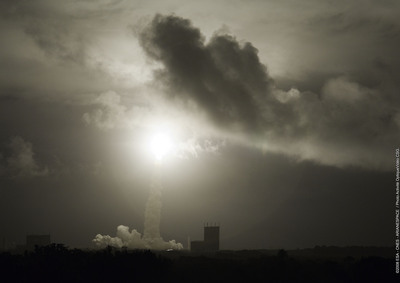
Subscribe to:
Posts (Atom)


